
CONVERSATIONS / books / FILM & TELEVISION
Ketanji Brown Jackson Was Ready Before History Called
Ketanji Brown Jackson Was Ready Before History Called
Justice Ketanji Brown Jackson joins Storehouse & Friends to reflect on Lovely One, the family and faith that grounded her ambition, the moments of doubt that tested it and the people who helped prepare her for a life she once could only imagine.
Storehouse & Friends | September 26 | 11 min read
SHARE

Justice Ketanji Brown Jackson joins Storehouse & Friends to discuss Lovely One and the family, faith and preparation behind her journey.
“If I’m ever in the deep end of any situation again, I will swim.”
-Ketanji Brown Jackson
The People Who Taught Her Who She Was
Jackson’s ambition began with identity. Her parents were intentional about that. They wanted her to understand her African American heritage and to carry pride in where she came from. Even her name was part of that inheritance.
Her aunt, who was serving in the Peace Corps in West Africa when Jackson was born, helped provide her parents with African names. Ketanji Onika, Jackson explains, means “lovely one.” Years later, during her first trip to Africa, that name created a moment she never forgot. A customs agent opened her passport.
He looked at her name. Then he looked at her. “Ketanji Onika, when did you leave us?” she remembers him asking.
Jackson explained that she was American and had never been to Africa before. The man smiled. “Welcome home.” The exchange connected something her parents had given her at birth to a place she was encountering for the first time.
That same sense of grounding came from her grandmother. Jackson describes growing up in predominantly white schools and spaces during the week, then spending time with her grandmother and attending church on weekends. The contrast mattered. Church felt like “a soul deep sigh of relief.”
There, she says, she found her people. She felt understood. She felt supported. That grounding helped create something she would need repeatedly throughout her life.
A sense of self strong enough to survive entering places where very few people looked like her.
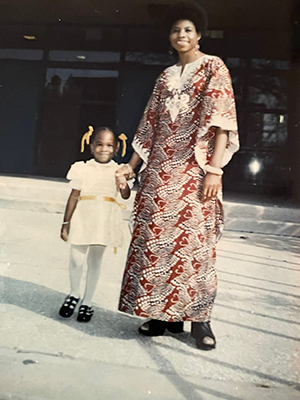
“Welcome home.”
Said to Jackson during her first trip to Africa,
Learning to Swim in Deep Water
Jackson learned one of her most enduring lessons in a swimming pool. She already knew how to swim. That was what made the experience so unsettling. At a family pool party, Jackson was floating when she opened her eyes and realized she had drifted into the deep end.
Then she panicked. Knowledge disappeared beneath fear. She began flailing. She sank.

“You have to find mentors who are willing to believe in you, and be a mentor when you get the chance to give back.”
Ketanji Brown Jackson
Watch the conversation
Ketanji Brown Jackson Was Ready Before History Called
Justice Ketanji Brown Jackson joins Storehouse & Friends to reflect on Lovely One, the family and faith that grounded her ambition, the moments of doubt that tested it and the people who helped prepare her for a life she once could only imagine.

MORE FROM STOREHOUSE &FRIENDS


The Malcolm X You Were Never Taught
11 MIN READ


A conversation about Friends of the Good.
11 MIN READ
Someone at the party jumped into the pool fully clothed and pulled her out. Jackson remembers feeling relieved. She also remembers being disappointed in herself. “I knew how to swim,” she says.
Nothing about her actual ability had changed. Her belief in that ability had. So she made herself a promise. “If I’m ever in the deep end of any situation again, I will swim.”
The lesson would return in places far removed from a swimming pool. At Harvard, Jackson struggled with self-doubt. She wondered whether she belonged. Whether she could perform at the level expected of her.
Whether she deserved to be there at all. Faith became part of the answer. During a difficult period, she received letters from her mother and aunt reminding her that she was protected and cared for. Then one day, an older woman Jackson did not know passed her on the street.
“Persevere,” the woman told her. Jackson never saw her again. She kept the message. She focused on what she could control.
The work. She performed well academically. Confidence followed. Not all at once.
“It was a process,” she says. The lesson was not that fear disappears when someone is prepared. It was that fear does not always deserve to make the decision.
Watch the conversation
Ketanji Brown Jackson Was Ready Before History Called
Justice Ketanji Brown Jackson joins Storehouse & Friends to reflect on Lovely One, the family and faith that grounded her ambition, the moments of doubt that tested it and the people who helped prepare her for a life she once could only imagine.

When One Dream Has to Make Room for Another
Jackson is careful not to tell the story of professional achievement as though everything around it arranged itself neatly. It did not. She was building a legal career. She was also building a family.
Those responsibilities sometimes competed for the same hours, energy and attention. “I wanted to not make it seem as though this all came easily for me,” she says. Motherhood brought its own questions. Was she giving enough to her daughters?
“To have a circle of people who can support and guide and encourage you is really crucial.”
-Ketanji Brown Jackson

Judge Ketanji Brown Jackson pictured with her two daughters and husband.
(Courtesy of the Brown Family)
Was her career taking something away from them? Could ambition and caregiving coexist without one constantly making the other feel inadequate? Jackson credits her husband, Patrick, with helping the family navigate those choices. Sometimes she stepped back so his career could move forward.
At other times, he supported hers. They respected one another’s professional ambitions while accepting that everything could not necessarily happen at once. That understanding became especially important when Jackson was considering the Supreme Court. The decision would not affect her alone.
Her family would become more visible. Her daughters’ lives could be examined publicly. For Jackson, their consent mattered. Her daughter Talia’s autism diagnosis was something Jackson knew might become public if she moved forward.
If Talia had been uncomfortable, Jackson says she was prepared to decline the opportunity. Instead, her daughter told her to go. This was who she was. Truth would be enough.
“We’ll be fine,” Jackson remembers her saying. Her other daughter, Leila, had already demonstrated her own confidence in her mother years earlier. As a child, she decided Jackson should become a federal judge. So she wrote to President Barack Obama and told him.
For Jackson, the letter answered a question she had quietly carried as a working mother. Her daughter had been watching. She understood what her mother did. And she was proud.
The Circle That Holds You Up
Jackson’s story is filled with individual achievement. She does not describe it as an individual accomplishment. Again and again, other people appear.
Parents. Grandparents. Teachers. Judges. Friends.
Her husband. Her daughters. Jackson talks about her close circle of women as people who have been present across different seasons of her life. They do not need to speak every day.
Their importance comes from knowing where to go when the difficult day arrives. “They’re out there always rooting for you,” she says. Those friendships were there when she met Patrick. Her friends questioned him.
Examined him. Made sure the man spending time with their friend understood there were people paying attention. Years later, they were there again during Jackson’s Supreme Court nomination process. They appeared publicly.
They spoke about her character. They offered perspectives built from actually knowing her. For Jackson, that kind of support is not incidental. It is part of how people endure demanding lives.
“To have a circle of people who can support and guide and encourage you is really crucial,” she says. The same principle applies professionally. Jackson encourages people to seek mentorship wherever they can find someone willing to invest in them. That did not always mean finding someone who looked like her.
Earlier in her career, there were fewer Black people occupying some of the positions she hoped to enter. So she learned from people who were willing to teach. Her high school speech and debate coach helped sharpen her reasoning and writing and introduced her to Harvard. She later clerked for three federal judges, including Justice Stephen Breyer.
Each relationship gave her something different. Eventually, mentorship became reciprocal. A person receives guidance. Then reaches a place where someone else needs theirs.
When Possibility Needs a Face
Jackson learned about Constance Baker Motley when she was young. Motley was the first Black woman to serve as a federal judge. Jackson also discovered that they shared a birthday. That coincidence stayed with her.
She already knew she wanted to become a lawyer. Her father had given her that model. Motley expanded the picture. “Maybe I can be a judge, not just a lawyer,” Jackson remembers thinking.
Representation worked not as decoration, but as information. Someone had done it. Therefore the path existed. That understanding now shapes the way Jackson thinks about her own story.
Part of her reason for writing Lovely One was to make the journey visible to someone else. Maybe another young person wants to practice law. Maybe another person imagines becoming a judge. Jackson wants them to know the possibility is real.
Her life also taught her that possibility does not eliminate uncertainty. The woman who eventually joined the Supreme Court is the same person who once questioned whether she belonged at Harvard. The child who declared her judicial ambitions in a high school yearbook is also the child who panicked after realizing she had floated too far into a swimming pool. Both belong in the story.
So do the people who reminded her what she knew when she temporarily forgot. That may be one of the more useful forms of representation. Not presenting accomplishment as inevitability. Showing the doubt beside it.
The work beneath it. The people surrounding it. And the moments when believing in yourself requires borrowing belief from someone else.
“Representation can function as information: someone has done it, which means the path exists.”
-Storehouse & Friends
A Conversation About More Than Making History
The Storehouse & Friends conversation with Justice Ketanji Brown Jackson is not simply about becoming the first Black woman to serve on the Supreme Court. It is about preparation. It is about faith. It is about family.
It is about motherhood. It is about friendship, mentorship and knowing who you are before entering places that may cause you to question it. And it is about what happens after a dream that once seemed distant becomes your actual life. Jackson’s story contains moments that, looking backward, can appear almost perfectly arranged.
The father studying law beside his daughter. The young girl learning about Constance Baker Motley. The high school student writing down her dream of a federal judicial appointment. The Harvard student being told to persevere.
The daughter writing to a president. The former clerk eventually succeeding the justice for whom she once worked. But Jackson’s telling does not erase what existed between those moments.
Fear. Questions. Competing responsibilities. Self-doubt. The ordinary difficulty of trying to be present for a family while also answering professional ambition.
That is part of Lovely One too. Not simply where Jackson arrived. How she kept going. Near the end of the conversation, Chapman asks Jackson to read the final words of her memoir.
Jackson begins with what has sustained much of the story. “I have faith.” She speaks of family. Friends.
Service. The Constitution and the rule of law. Art. Then she asks one final question.“How much more lovely can anyone’s life be?” The title of the memoir began with a name her parents gave their daughter. By the end, it has become something larger. A life can contain fear and still be lovely.
Responsibility and joy. Sacrifice and ambition. Deep water and the knowledge that you already know how to swim. Perhaps that is what Jackson’s journey leaves behind for the person standing at the edge of their own unfamiliar room.
The question is not whether the water will ever become deep. Eventually, it will. The more important question is:
When it does, will you remember that you already know how to swim?
“I have faith.”
-Ketanji Brown Jackson






more from storehouse & friends

Style, Identity, and the Power of Self-Definition
11 MIN READ